

Let’s talk about sex, shall we? No not human sex, on which I would scarcely consider myself an expert, but bird sex. Actually not bird sex as such, but rather the sex of birds.
Curiosity thoroughly aroused1, I’ll explain myself. The sex of birds intersects neatly with another of my favourite topics: the names of birds. Many birds are, of course, named after the way they look. Since male and female birds sometimes look different from each other, it stands to reason that the name of a given bird may better reflect one sex than the other.
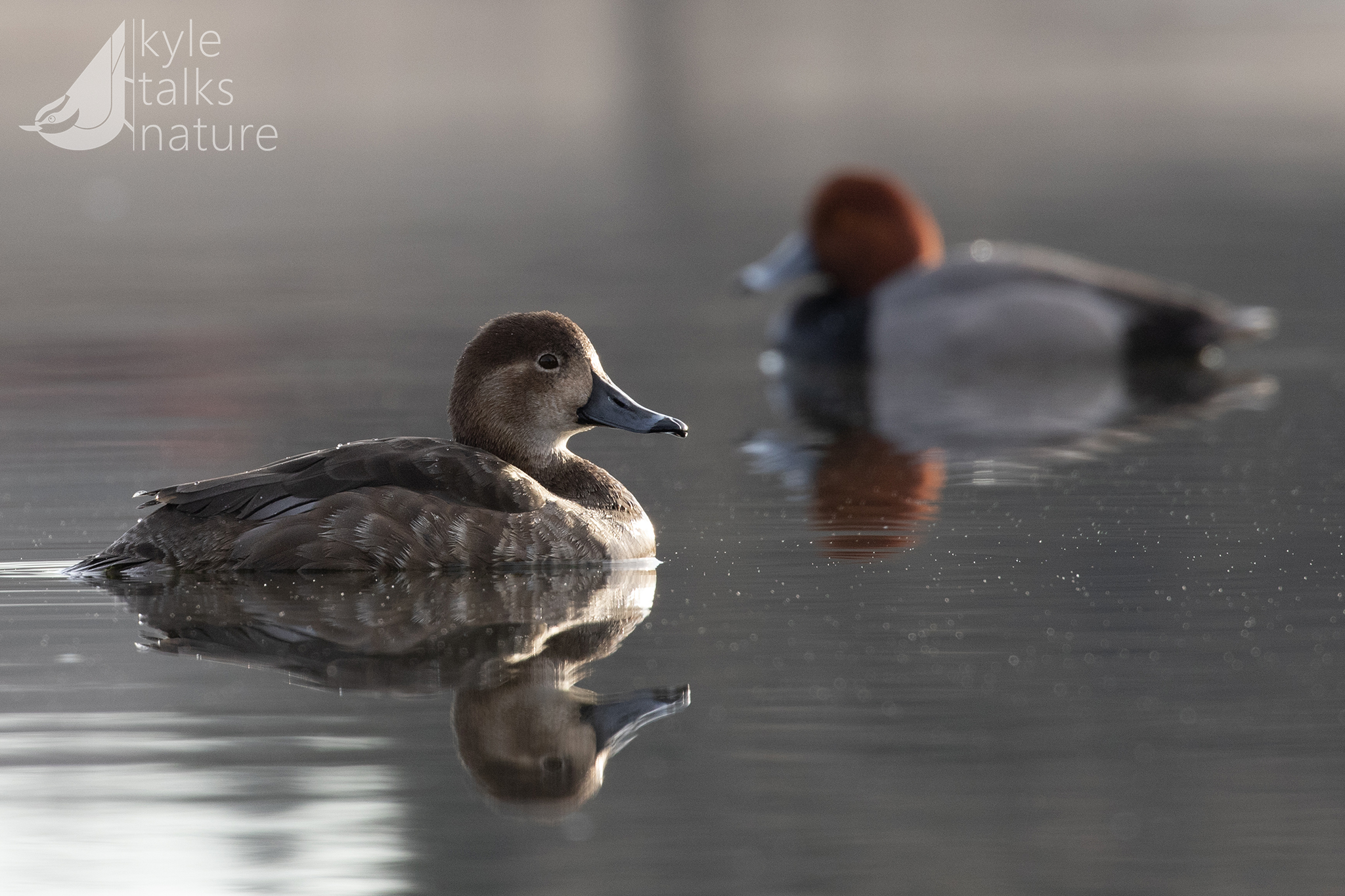
It’s a short leap from that basic idea to imagine that there could be a bias in bird names, with disproportionate representation of one sex over the other. Given that male birds tend to be more brightly coloured than their counterparts, and given the sex of most bird-namers, the direction of that bias is probably obvious2.
It would not be wildly inaccurate to suggest that female birds have, throughout the history of ornithology, gotten a bit of a raw deal. A majority of bird research has focused on males, with a startling amount of female biology misunderstood, ignored, or based on assumption alone3. Not just a matter of fairness, this sex disparity has a real impact on bird conservation. As researchers in the area have been quick to point out, female birds are rather essential for the survival of a species.
In bird literature, too, female birds are often under-represented. In many older field guides, female birds are depicted smaller than the males, in less detail, or in some cases not at all. In the oldest bird book on my (very limited) shelf — a 1964 printing of Peterson’s A Field Guide to the Birds — the females are buried behind the males, often obscuring important features.
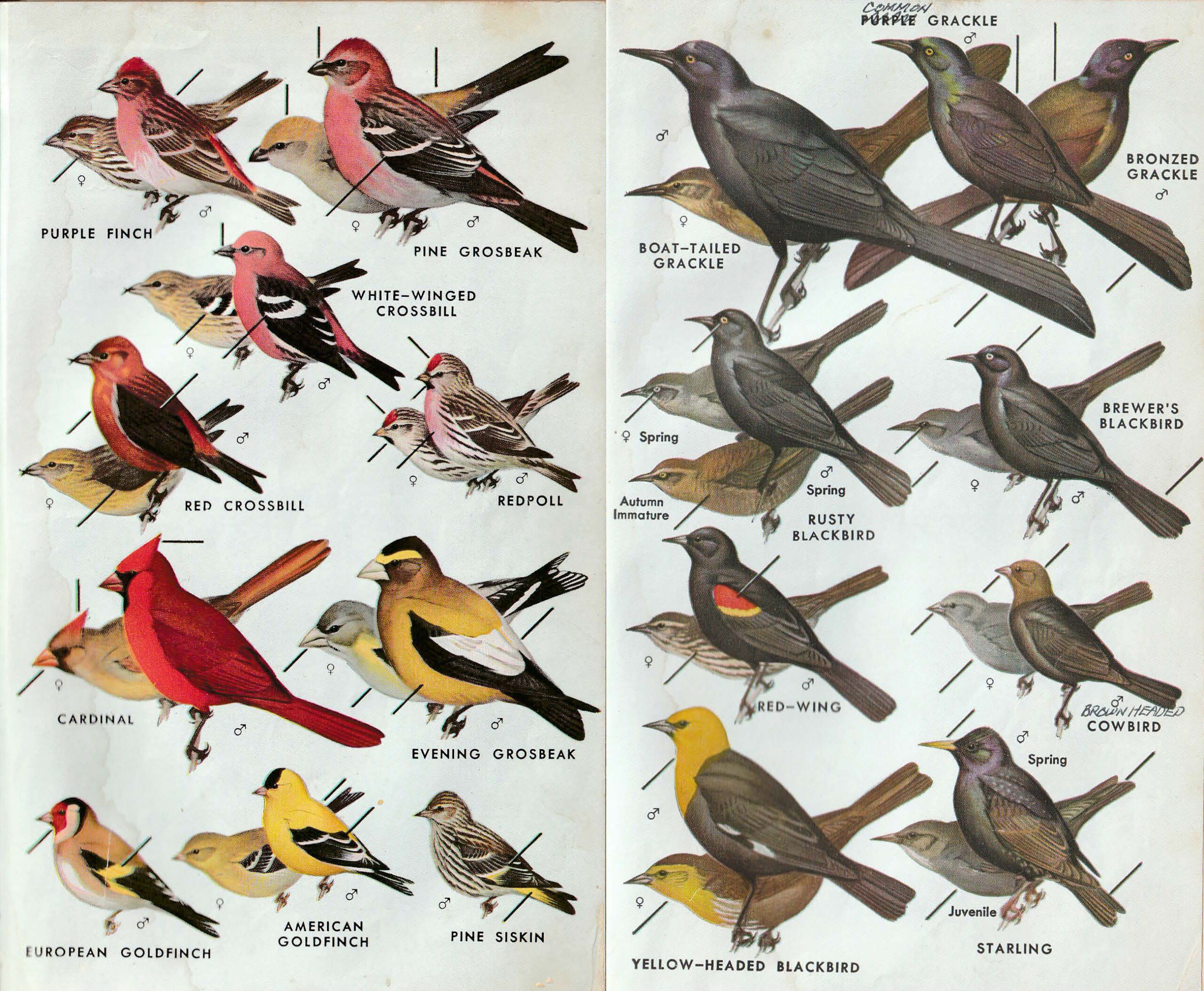
Modern field guides have largely improved on this disservice, but it would still be hard to argue that male birds don’t get the bulk of many birders’ attention4. And while it’s fair to say that their brighter colours and conspicuous behaviours often make them easier to spot and identify, we owe the females equal billing. If anything, the greater difficulty in identifying and learning about females should earn them more space on the page.
But I digress, as usual. Back to the business of naming. The male-bias in bird names has been the subject of some discussion recently, on social media and in articles like this one and this one. The idea is not new, though. It runs all the way back to arguably the first true field guide to birds in North America: Birds Through an Opera Glass by Florence Merriam Bailey. Among her beautiful, characterful descriptions of the birds, she opines on the Black-throated Blue Warbler:
“Like other ladies, the little feathered brides have to bear their husbands’ names, however inappropriate. What injustice! Here an innocent creature with an olive-green back and yellowish breast has to go about all her days known as the black-throated blue warbler, just because that happens to describe the dress of her spouse!”
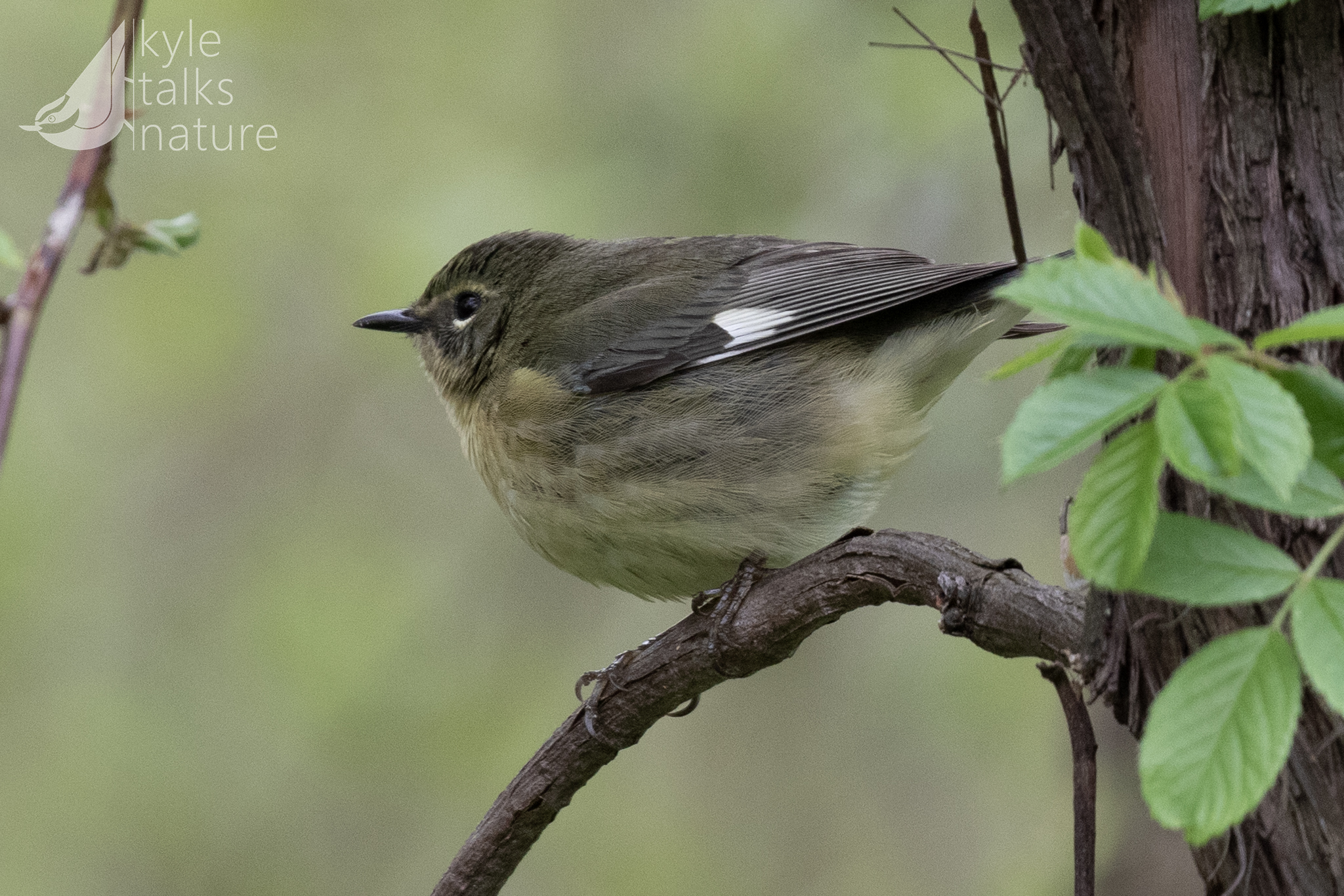
The Black-throated Blue Warbler is a seminal example of this very issue, and one of several that is often raised. What I haven’t seen in the discussion, though, is an actual accounting of how widespread the male naming bias truly is. If you know me, you know I love any excuse to pore through bird checklists, and this one seemed as good as any.
So how do we get some cold, hard numbers on this thing? First we need a sample, because as much as I love bird checklists, I’m not manually checking the sex bias of over 11,000 bird names. So, as I am North American in persuasion, I looked at all species that occur at least annually in the ABA Area5. This gives us a manageable sample of 840 bird names.
From there, it’s just a matter of manual review. Obviously, as I am presumably a human being6, this entails some possibility of error and some need to make judgment calls. I am mentally and emotionally prepared for your rebuttals7.
In my opinion, among those 840 birds there are exactly 38 which are clearly male-biased. They are as follows:
| Black Scoter | Purple Finch |
| Black-capped Gnatcatcher | Red Crossbill |
| Black-chinned Hummingbird | Red-breasted Merganser |
| Black-chinned Sparrow | Red-cockaded Woodpecker8 |
| Black-headed Grosbeak | Redhead |
| Blackpoll Warbler | Red-winged Blackbird |
| Black-throated Blue Warbler | Rose-breasted Grosbeak |
| Blue Grosbeak | Rose-ringed Parakeet |
| Bluethroat | Ruby-crowned Kinglet |
| Blue-throated Mountain-gem | Ruby-throated Hummingbird |
| Chestnut-collared Longspur | Ruddy Duck |
| Cinnamon Teal | Ruff |
| Harlequin Duck | Ruffed Grouse |
| Hepatic Tanager | Scarlet Tanager |
| Indigo Bunting | Shiny Cowbird |
| King Eider | Siberian Rubythoat |
| Lazuli Bunting | Tricolored Blackbird |
| Long-tailed Duck | Varied Bunting |
| Lucifer Hummingbird | Vermilion Flycatcher |
This list represents about 4.5% of the total which, if I’m honest, is a smaller chunk than I expected. For most, the reason for their inclusion should be relatively clear. A female Red-breasted Merganser, for example, does not have a red breast, and a female Red-winged Blackbird is neither red-winged (usually9) nor black.
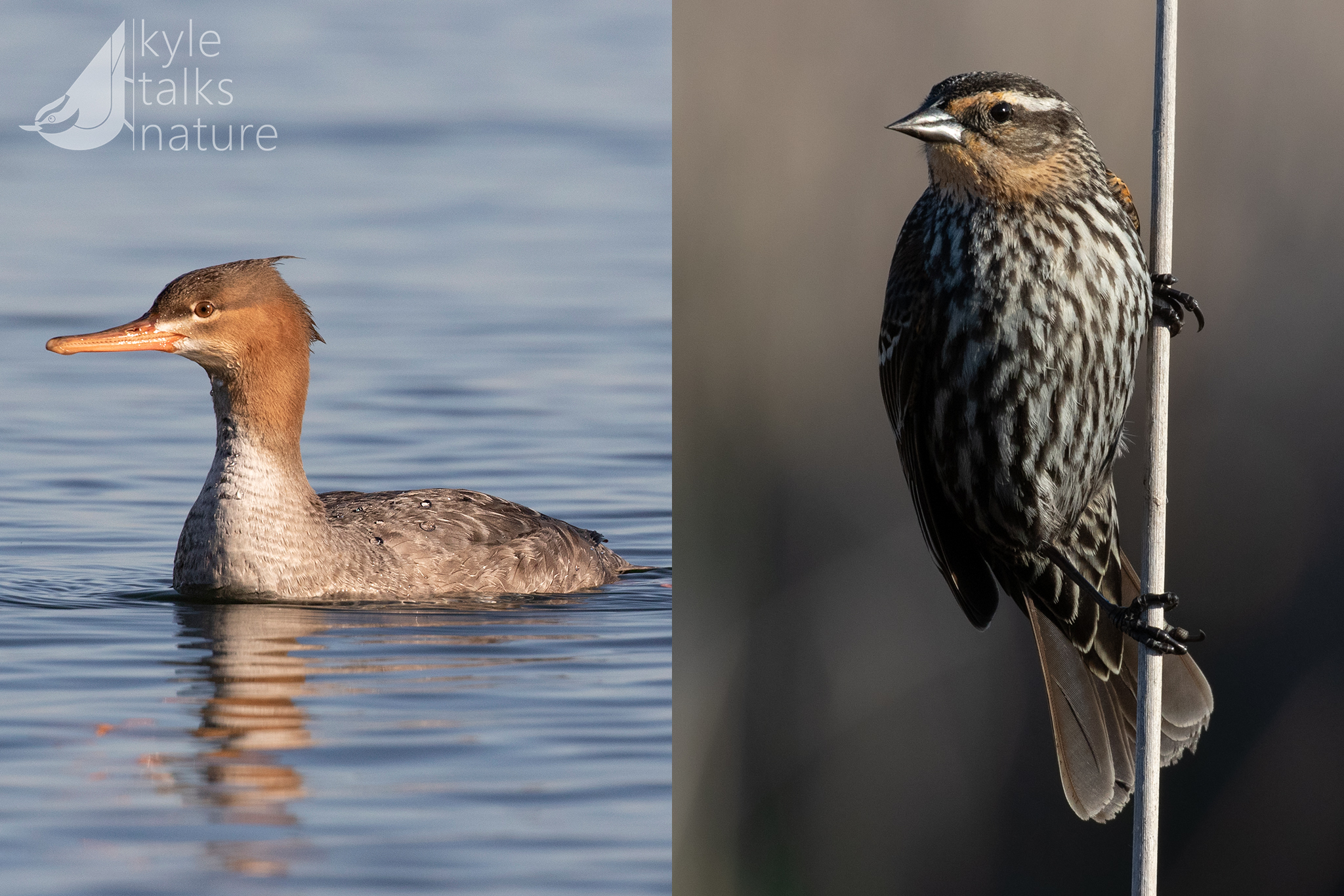
King Eider and Lucifer Hummingbird are a little unusual, as neither name is strictly descriptive, but both are the names of male things and are surely references to the males’ plumage. Ruff definitely belongs on the list too, as its name refers to the male’s elaborate collar, but is noteworthy as the female has her own commonly-used name: Reeve. Still, the male’s is the official name of the species, so it stays.
A caveat here is that I have not included birds named for their songs, like Bobolink or Song Sparrow. In some species only the male sings, and that would make these names male-biased too. In others, though, the female also sings, and much about female song is still being uncovered10. Teasing those apart may be a battle for another time.
In addition to the 38 birds above, there are 24 names that I labeled as “ambiguously male-biased”. These, in my opinion, are up for debate. I present them here with my rationale. Feel free to @ me.
- American Goldfinch – Clearly named for the vibrant yellow (not gold) of the breeding male. Arguably gold is not an unreasonable description of the female.
- American Redstart – Named for the flashes of colour in the tail of the male, likely by someone familiar with the unrelated Common Redstart of Eurasia. However since the flashes are orange it is arguably an equally bad name for both sexes (the female’s flashes are yellow).
- Boat-tailed Grackle – The namesake feature is certainly much more pronounced in the male, but perhaps a matter of degree.
- Brewer’s Blackbird – Blackbirds may have a problem as a group. A female Brewer’s, like many others, is brown.
- Bronzed Cowbird – Named for the bronzy-black plumage of the male. Tricky, as females in the east are blackish and even a bit bronzy, while females in the west are plain brown.
- Brown-headed Cowbird – Males are black with brown heads. Females are brown all over, so you’d have to conclude this name is not technically incorrect…
- Canvasback – Named for the crisp, whitish back of the male. The female’s back is a smudgier canvas for sure, but I’m not sure that disqualifies her.
- Cerulean Warbler – The male is indeed blue, but the female is an equally spectacular and unique shade of blue-green. I’m not sure the scope of the word ‘cerulean’. Might need an art degree for this one.
- Dusky Grouse – Almost didn’t include this one…surely named for the black and grey male, but the female is mottled grey and brown which certainly still qualifies as dusky.
- Eastern Bluebird – All three bluebirds are on this list, but perhaps shouldn’t be. All females show at least some blue, if not as much as their counterparts.
- Flame-colored Tanager – A matter of degree, as the female is a more subdued version of the male.
- Great-tailed Grackle – See ‘Boat-tailed Grackle’.
- Hooded Warbler – A matter of degree here too. The male wears a complete black hood. The female’s hood is less pronounced and may be incomplete, but it’s still there.
- Lesser Goldfinch – See ‘American Goldfinch’.
- Mountain Bluebird – See ‘Eastern Bluebird’.
- Northern Cardinal – The word ‘cardinal’ is certainly a reference to the red plumage of the male, though she wears red too, albeit only as an accent.
- Orange-crowned Warbler – Males wear an entirely inconspicuous orange crown. Some females have a smaller orange crown, while others have none at all.
- Red Avadavat – Almost exactly the same as Northern Cardinal, wherein the male is very red and the female sports a little red.
- Rufous Hummingbird – Named for the very-rufous male, but perhaps still applicable to the partly-rufous female.
- Rusty Blackbird – You’d think the Rusty makes the list because the female lacks that colour, but at times she is more rusty than the male. She’s never black, though, having the same problem as the related Brewer’s Blackbird.
- Saffron Finch – Presumably named for the orange blushing on the male’s face. Females are highly variable depending on the subspecies…in some they may show this feature slightly, while in others the females are plain brown. A similar issue to Bronzed Cowbird.
- Sooty Grouse – See ‘Dusky Grouse’.
- Western Bluebird – See ‘Eastern Bluebird’.
- Yellow-headed Blackbird – Arguably the least contentious of the North American Blackbirds. The female can be dark brown, approaching black, and does wear some yellow on her face and throat.
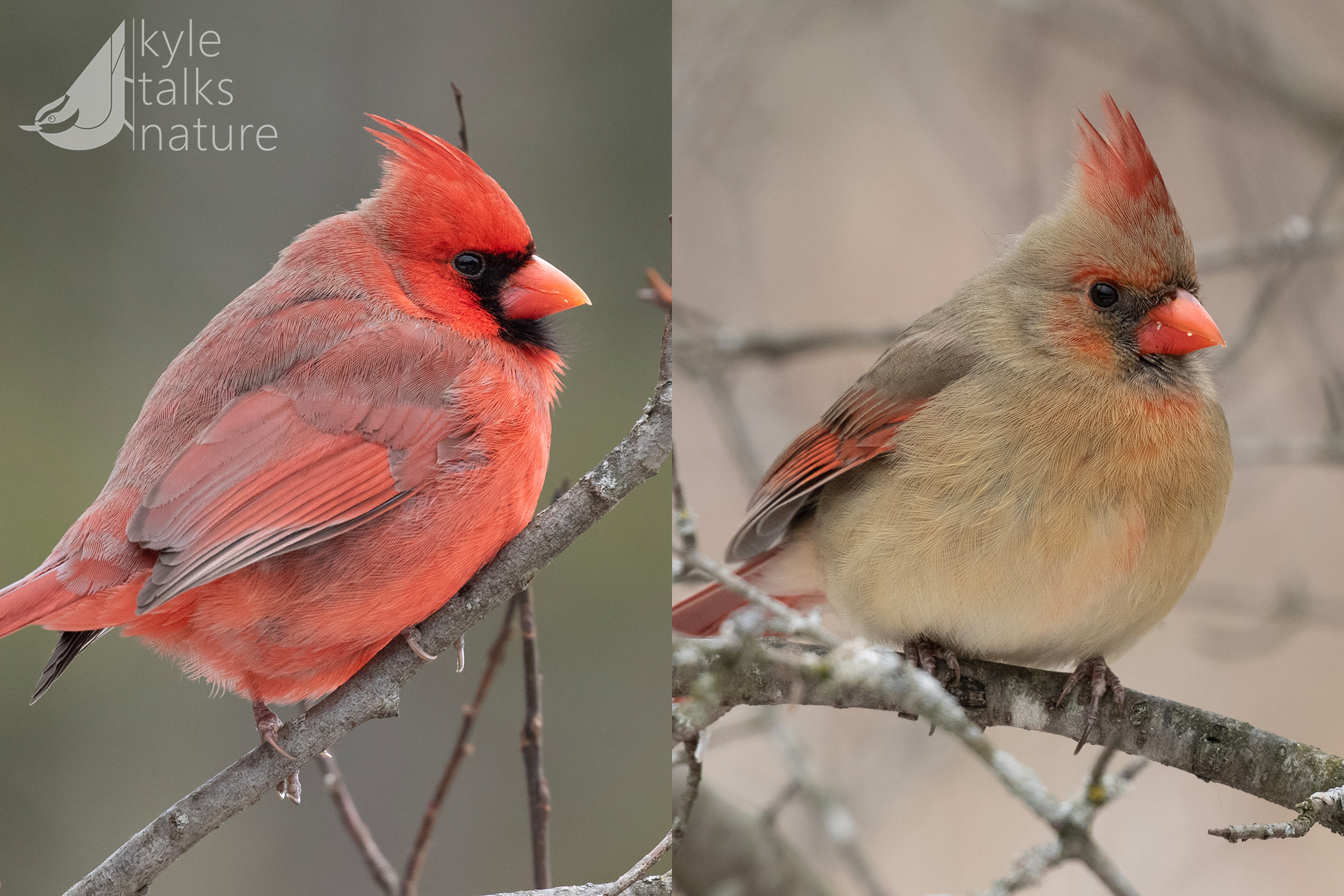
It became apparent through this exercise that a few groups of birds are disproportionately guilty of this bias. The cardinals and related buntings, grosbeaks, and tanagers feature strongly, and the number of hummingbirds on the list is limited only by the small number that occur in the sample area. Globally, I wouldn’t be surprised at all to find that hummers are the biggest culprits11.
Finally, I would be remiss in not recognizing those few bird names that are female-biased, in particular the Belted and Ringed Kingfishers in which the females wear the namesake features. An argument could be made for Red Phalarope too — the female may lean towards the orange side of red, but the faded male isn’t even close.
There, then, is the list, for what it’s worth. It’s not my intention to suggest a solution, or even whether one is necessary. If I’m honest, I have mixed feelings myself. But I think it’s a discussion well worth having, at the very least when naming new species or undertaking other renaming efforts. More than a symbolic gesture12, names that suit both sexes are better for birders too, making the birds easier to learn. Maybe they even set the tone for equal ornithological treatment in the future.
Did I miss any? Do you agree or disagree? Let me know! I can take it. Maybe.
1 Sorry.
2 It’s male.
3 I promise I’m not making this up. See this study and this other study, for starters.
4 For a counterpoint to this, and more on why you should pay more attention to female birds, maybe check out the Galbatross Project (@galbatrossproject on Instagram)
5 For those who want the nitty-gritty, I used the most recent ABA Checklist and pared it down to birds with checklist codes 1-3.
6 Jury’s out.
7 Not really.
8 The Red-cockaded Woodpecker is not male-based for the reason you’re thinking (get your head out of the gutter). A cockade is, you guessed it, a hat ornament, and only the male wears this tiny red detail. Somehow this is among the least dirty woodpecker names.
9 The orange or rusty epaulettes of the female may border on red in some older individuals, but I can’t in good conscience give them a pass for that.
10 I wasn’t lying about the lack of study on female birds. The Female Bird Song Project has been created to try to remedy this shortfall.
11 Seriously, what would you even do about the hummingbirds??
12 Though still absolutely valid as a symbolic gesture.